Train Attack: Merge War
- 4.4
- Rating
- 1.00M
- Installs
- Free
- Price
 Analysis by App-foxy
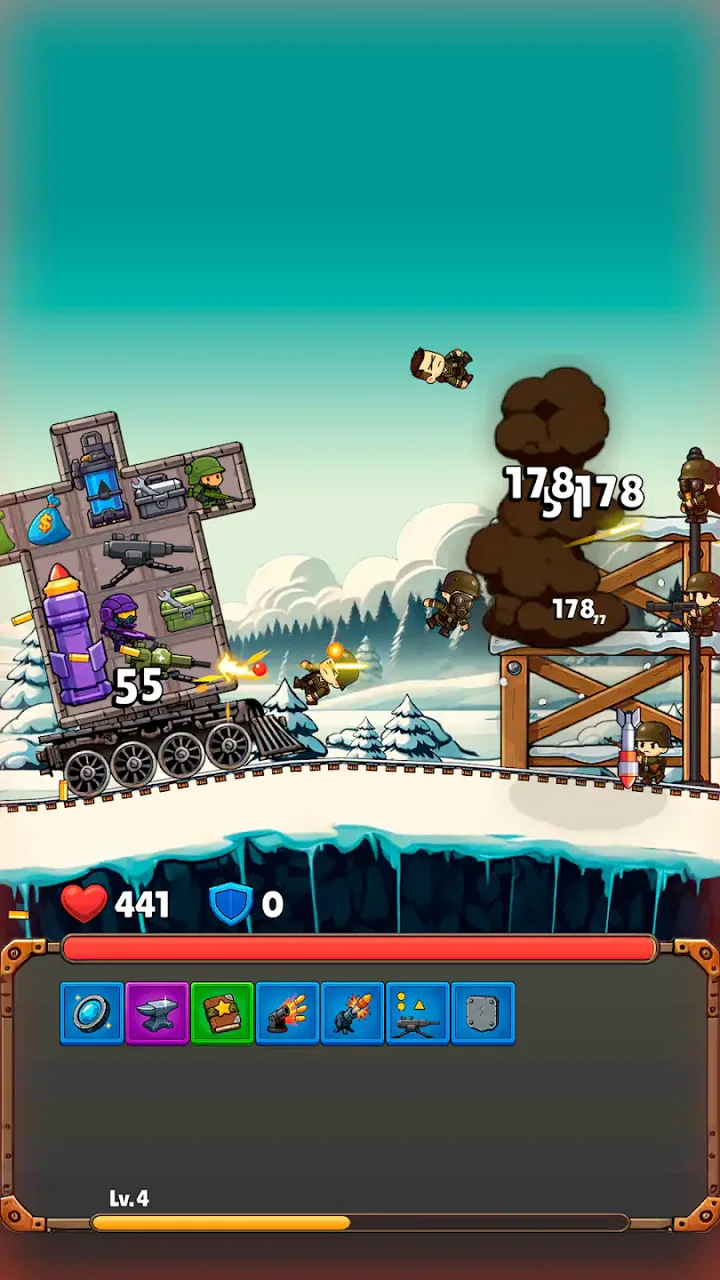
I spent my first sessions with Train Attack: Merge War expecting a quick merge game with a train-shaped theme, and that is exactly where its immediate appeal comes from. The basic idea is easy to understand: combine guns, improve the firepower attached to your battle train, and send that growing machine into fights. It belongs to the strategy category, but it is deliberately lighter than a traditional strategy game that asks you to manage a large map, several resources, or a complicated army.
That simplicity makes it comfortable to pick up when I only have a few minutes. I can see the attraction for someone who likes watching a weak setup become more capable through a series of small upgrades. The train gives the action a clear identity, while the merging mechanic keeps the early decisions readable. I do not need to study a long tutorial before understanding what I am supposed to do.
The game is free to download, with optional purchases listed from $0.99 to $114.99 per item. It is made by MAD PIXEL GAMES LTD, carries an Everyone 10+ content rating, and supports devices running Android 7.0 or later. Those details make it accessible to a broad audience, although the presence of optional purchases is worth remembering before handing the game to a younger player.
You May Also Like

 Blood Strike: 2.5 Anniversary
Blood Strike’s Loadouts Turn Every Drop Into a Tactical Gamble
A close look at Blood Strike’s custom loadouts: how fast access to signature weapons reshapes its battle royale rhythm, rewards preparation, and narrows the gap between fights.

 Pandora - Music & Podcasts
Pandora’s Music Is Easy to Start, but Harder to Recover
Pandora’s strength is its low-effort path from a seed to a station. Its weak spot is how much confidence it asks you to place in connection, setup, and quiet recovery.

 8 Ball Pool
 Is Built on Rivalries, Rematches, and Routine
A close look at the rivalries, rematches, shared routines, and unanswered safety questions that turn a quick pool match into a persistent mobile community.

 Samsung Music
’s Quiet Strength Is Playing What You Already Own
Its reach comes less from spectacle than from dependable access to a personal library. That simplicity is both the app’s strongest retention engine and its ceiling.

 AccuWeather: Weather Radar
AccuWeather Review: A Quick, Clear Forecast for Everyday Decisions
For everyday plans, the best forecast is the one you can understand quickly. AccuWeather makes rain timing, radar, and local conditions easy to act on, with a few trade-offs.

 Hill Climb Racing
Why Hill Climb Racing Still Turns Crashes Into One More Run
A tiny car, a bumpy hill and one more upgrade: Hill Climb Racing keeps resurfacing because its simple chaos makes every near-miss feel personal.
More From Our News Desk



Why the first week feels rewarding
The strongest part of the opening experience is the feedback loop. I merge a weapon, see the train become more capable, and then get another reason to improve the formation before the next fight. That chain of small rewards is familiar, but the train setting gives it more personality than a completely abstract board of numbered objects.
During the first week, the game works well as a short-session habit. I can open it while waiting for transport, play between other tasks, and stop without feeling that I have committed to a long campaign. The controls and objectives are approachable enough for casual players, yet there is still a small layer of decision-making in choosing when to combine equipment and when to keep separate pieces available.
That timing matters more than it may seem. Merging immediately is satisfying, but it can also leave a player with fewer individual weapons available for the next encounter. I found it more useful to pause before every combination and consider whether the stronger gun actually improves the current battle or simply looks better on the board. This is one of the first practical lessons the game teaches without making a formal strategy exercise out of it.
The train itself also helps with readability. Instead of managing an anonymous collection of units, I am building one recognizable fighting machine. That makes progress feel more coherent. Each improvement contributes to the same object, so the early game has a clear sense of direction even when the individual actions are simple.
New players should not expect the depth of a full-scale tactics game. The appeal is closer to an accessible merge battler than to a detailed war simulation. If you enjoy planning several turns ahead, controlling different troop types, or shaping a large economy, the first week may feel shallow. If you prefer quick decisions and visible upgrades, the opening hours are much easier to appreciate.
The game has reached over a million installs and holds a 4.4 average from around twenty-three thousand ratings, which fits my impression of its broad, easy-to-enter design. That popularity does not guarantee that it will suit every player, but it does suggest that the core loop is understandable enough to attract a substantial casual audience.
Small decisions that improve the opening sessions
My best early habit was to avoid treating every available merge as automatically correct. I kept an eye on the immediate fight rather than chasing the largest possible weapon at all times. A stronger combined gun can be useful, but preserving a couple of separate options may give the train more flexibility when the next encounter demands a different arrangement.
I also learned to use the first sessions as a test of my tolerance for repetition. The game’s loop is intentionally focused. It does not hide its main activity behind a long story or a complicated collection system. That is good if I want a clear, low-pressure routine, but it means the novelty depends heavily on whether merging and upgrading remain satisfying after the first visual excitement fades.
Another useful approach is to set a stopping point before beginning a session. Because the next upgrade is usually close enough to feel tempting, it is easy to continue longer than planned. A short limit keeps the game in its best role: a compact strategy distraction rather than an obligation that fills every spare moment.
What remains after the novelty wears off
The more important question is not whether the first few days are enjoyable. They are. The real test is whether the train continues to offer meaningful decisions once the basic pattern becomes familiar. In my experience, the answer depends on what I want from a strategy game.
For players who enjoy incremental progress, the recurring value is straightforward. There is always a reason to improve the train, merge another weapon, or prepare for the next confrontation. That structure can make the game a pleasant background habit. It is especially suitable for someone who likes mobile games that provide a sense of advancement without demanding a long uninterrupted sitting.
For players who need constant mechanical variety, the situation is less favorable. The central loop remains the central loop. Even when the battles feel more exciting because the train is stronger, the act of combining guns does not suddenly become a different genre. Once I understood the rhythm, I could predict much of the experience: gather or arrange equipment, merge where useful, enter a fight, then repeat the process.
That predictability is not automatically a flaw. Some people want exactly this kind of dependable routine. I often prefer it when I am tired and do not want to learn a new system. The problem appears when I open the game out of habit rather than because I am interested in the next decision. At that point, the distinction between satisfying progression and simple repetition becomes important.
The current version is 1.3.5, so the experience should be judged as a living mobile title rather than a finished one-time puzzle. Updates can help a game like this by refreshing the reasons to return, but long-term enjoyment should not depend entirely on hoping that future content will solve present boredom. I would install it for the loop it offers now, not for an imagined expansion.
How it compares with familiar strategy alternatives
Compared with a conventional tower defense game, Train Attack: Merge War is easier to enter and less demanding to plan around a fixed map. I am not spending as much time studying lanes, enemy paths, or a broad defensive layout. The train keeps the focus on the strength and arrangement of its weapons, which makes each session more direct.
Compared with a classic merge puzzle, it adds a clearer combat purpose. The objects are not merely being combined for a score; they are connected to a battle train that needs to survive or overpower its opposition. That context gives the merging a little more urgency. Still, someone who wants a pure puzzle with carefully balanced board manipulation may find the combat framing less important than the merge action itself.
Compared with a deep collectible strategy game, this is the lighter choice. I would pick it when I want quick progress and minimal setup. I would choose the deeper alternative when I want extensive team building, complex counters, or a long-term plan that changes substantially from one session to another. The right comparison is not which game is better in every situation, but whether I want a compact train-building loop or a broader strategic hobby.
It also differs from idle games in an important way: the satisfaction here comes from my immediate interaction with the weapons and the train rather than from simply checking accumulated rewards. If I want a game that mostly plays itself, this may require more attention than expected. If I want to make a few choices and see their effect directly, that involvement is a strength.
The cost of keeping it in a routine
The maintenance burden is relatively low in terms of learning. I do not need to remember a large rulebook every time I return. The basic purpose remains clear, and that makes the game convenient for irregular play. I can leave it alone for a while and come back without feeling completely lost.
The bigger burden is attention. Because the loop is built around repeated small improvements, the game can encourage frequent checking. That may be enjoyable for a player who likes a steady stream of short goals, but it can become tiring for anyone trying to reduce notifications, screen time, or impulse-based play. I would recommend treating it as an optional break rather than allowing it to become the default response to every idle moment.
Purchases also deserve a deliberate approach. The free entry point is useful because it lets me test whether the merge-and-battle cycle suits me before spending anything. The listed purchase range, however, stretches from a very small amount to a much larger one, so I would not make a purchase simply because the next upgrade feels slow or a battle becomes frustrating. The sensible test is whether the game remains enjoyable without paying.
This is particularly relevant for families. The Everyone 10+ rating makes the game broadly approachable, but the purchase options mean that device-level spending controls are still a sensible precaution. The age label describes suitability; it does not replace a conversation about buying items inside a free game.
Device compatibility is another practical advantage. Support for Android 7.0 or later means many older Android devices can potentially run it, which suits the game’s casual role. I would still judge the experience on the actual phone rather than assuming that compatibility guarantees perfect comfort. A strategy game based on repeated visual decisions is much nicer when the screen is responsive and the interface is easy to inspect.
Where fatigue begins
My main source of fatigue was not difficulty itself but the possibility that progress could start to feel too similar from one session to the next. The first upgrades are exciting because they visibly change the train’s capabilities. Later, the emotional impact depends more on whether the next improvement creates a meaningful tactical choice or merely raises the same general power.
This is why I would not recommend marathon sessions. The game is better in small portions, where the merge loop still feels active. Playing for too long can expose its repetition quickly, especially for someone who normally prefers story-driven games or strategy titles with several distinct phases.
There is also a trade-off between clarity and depth. The focused design makes the game friendly, but it leaves less room for elaborate experimentation. A player can understand the important action quickly, yet that same accessibility may limit the number of surprising discoveries available later. I appreciate the clarity, but I would not mistake it for a highly complex tactical system.
Another possible friction point is the temptation to value visible growth over sound timing. A large weapon or more impressive train can feel like progress even when the current situation calls for a more balanced arrangement. I found the game more interesting when I resisted that instinct and asked what would help the next fight, not what looked strongest in isolation.
Who should make room for this train?
I think Train Attack: Merge War is a good fit for casual strategy players who want a free, approachable game with a clear upgrade loop. It works particularly well for short breaks, for players who enjoy combining objects, and for anyone who likes the idea of gradually turning a modest train into a more capable battle machine.
It is also a reasonable choice for someone who finds traditional strategy games intimidating. There is no need to begin by understanding a complicated battlefield. The train provides a single focus, and the merge mechanic gives immediate feedback. That makes the first step less demanding than many games that use the strategy label.
I would skip it if my priority were deep tactical variety, an involved campaign, or a game that constantly introduces new forms of play. I would also be cautious if I am trying to avoid repetitive progression loops or if I tend to spend impulsively when free games slow down. In those cases, a premium strategy game with a fixed price, a puzzle with more varied challenges, or a traditional tower defense title may be a better use of time.
The game is most convincing when I approach it with the right expectation: not as a complete replacement for a major strategy experience, but as a compact merge battler that gives me a reason to make a few decisions and watch the train improve. That framing prevents disappointment and makes its strengths easier to notice.
My long-term verdict
After the initial novelty fades, the game earns space on my device only if I keep sessions short and value steady progression over constant surprise. Its strongest quality is accessibility. I can understand the objective quickly, make a visible improvement, and return later without rebuilding my understanding from scratch.
Its weakness is the same focused loop that makes it approachable. If merging guns and strengthening the train stops feeling rewarding, there is not a large collection of unrelated systems waiting to carry the experience. The game cannot completely hide repetition with complexity, so its long-term value depends on whether the basic rhythm remains pleasant.
I would keep it installed as an occasional pick-up-and-play strategy game, especially for short waiting periods. I would not make it my only mobile game, and I would not spend money until I had already proved to myself that the free loop has become a stable habit rather than a brief curiosity.
With an average of 4.4 from roughly twenty-three thousand ratings, it has clearly found an audience, and I can understand why. The train theme gives the familiar merge formula a distinct shape, while the simple battles make it approachable. My final recommendation is positive but measured: try it for the first-week loop, then keep it only if the decisions still feel worthwhile after the visual novelty has gone.
FAQs for Train Attack: Merge War
01What is the main objective of Train Attack: Merge War?
In Train Attack: Merge War, the primary goal is to strategically merge and upgrade your train units to fend off enemy attacks. As you progress, you'll unlock new units and abilities to enhance your train's strength, aiming to achieve higher levels and scores. The game combines strategy and action elements, challenging players to think tactically.
02Is Train Attack: Merge War free to play, and are there in-app purchases?
Train Attack: Merge War is free to download and play on both Android and iOS platforms. However, the game offers optional in-app purchases that can enhance gameplay by providing additional resources, faster upgrades, and unique items. Players can enjoy the game without spending money, but purchases can offer a more streamlined experience.
03What are the system requirements for Train Attack: Merge War?
To run Train Attack: Merge War smoothly, Android users need a device running Android 5.0 or higher, while iOS users require iOS 10.0 or later. The game is optimized for a wide range of devices but performs best on newer models with more RAM and processing power. Ensure your device meets these specifications for optimal gameplay.
04Does Train Attack: Merge War require an internet connection?
Train Attack: Merge War can be played offline, allowing users to enjoy the game without an internet connection. However, some features, such as in-game events, updates, and purchases, require an online connection. Playing online also allows for leaderboards and social interactions, enhancing the overall experience.
05How does merging work in Train Attack: Merge War?
Merging in Train Attack: Merge War involves combining two identical train units to form a more powerful one. This mechanic is crucial for advancing in the game, as it upgrades your train's capabilities to tackle tougher enemies. Strategic merging is essential, as it determines the strength and efficiency of your train during battles.
Pros
- Engaging gameplay with strategic depth.
- High-quality graphics and animations.
- Intuitive controls for easy navigation.
- Regular updates with new content.
- Offline mode available for on-the-go play.
Cons
- Ads can be intrusive at times.
- In-app purchases may be costly.
- Some levels feel repetitive.
- Requires a stable internet for updates.
- Battery consumption is relatively high.

Train Attack: Merge War
Gallery